
Oklahoma County Arrest Records and Court Charges
An arrest record is the account of an arrest. It names who was taken in, the arresting agency, the date, and the booking. In Oklahoma County, that booking side runs through the Detention Center. The charge record is a separate thing. After an arrest, the District Attorney reviews the police report and decides what crimes to charge. Those formal charges are filed with the Court Clerk. From that point they live in the District Court case file, where each count carries a code, a level, and a status that can shift over time.
Two records, two homes. The jail roster and booking detail belong to the custody side, which you can reach through the Oklahoma County inmate records page. The court charges after arrest belong to the case file the clerk keeps. Want the full case file, with pleas, hearings, and the final result? That lives in the Oklahoma County criminal court records. The charge record is the slice that shows what was filed and how each count stands right now.
The county explains the prosecutor's role on the Oklahoma County district attorney about-the-office page.
That office is the one that turns an arrest report into a filed charge. The arrest does not set the charge by itself. The prosecutor does, and that step shapes the whole charge record.
Find Oklahoma County Arrest Records
Most Oklahoma County charges show up in two free state systems. The Oklahoma State Courts Network, known as OSCN, is the main official docket site. On Demand Court Records, or ODCR, is a second public portal that participating courts publish through. Both let you search by name or by case number. Charges, counts, and charge status appear inside the case once you open it. Booking detail and the live jail roster are kept apart from the court docket.
- Open the OSCN docket search and pick Oklahoma County District Court, or use the ODCR public search.
- Search by the defendant's name, or type a case number such as CF-2014-1.
- Open the case and read the charge list count by count.
- Check each charge's code, level, and current status before you draw any conclusion.
A statewide criminal history is a separate lookup. The Oklahoma State Bureau of Investigation keeps the official record that pulls charges from many counties into one history. The court dockets show charges one county at a time, so use both when you need the full picture.
Note: OSCN and ODCR are free to search, but online document images vary by case, and older or certified copies may need a Court Clerk request instead.
Who Files Oklahoma County Charges
The choice to charge belongs to the District Attorney, not the police. Vicki Behenna leads the Oklahoma County District Attorney's office, the largest such office in the state. Her office makes up the Seventh Judicial District of Oklahoma. Prosecutors there, called Assistant District Attorneys, represent the State of Oklahoma in both misdemeanor and felony cases. They turn an arrest report into filed charges when they accept a case.
The county lays out that prosecution role on the Oklahoma County District Attorney page.
That office is the gate between an arrest and a formal charge. An arrest can be made on the spot. A charge waits for review, and a prosecutor can decline a case the police sent over.
How Oklahoma County Charges Get Filed
The path runs in order. An arrest and booking come first. Then the prosecutor reviews the arrest report and the proof behind it. If the case is accepted, the charge record begins when a charging document is filed with the court. Three main types start a criminal case in Oklahoma, and the one used depends on the level of the crime and the route the state takes.
| Complaint | Information | Indictment | |
|---|---|---|---|
| Filed By | Officer / Prosecutor | Prosecutor | Grand Jury |
| Common For | Misdemeanors | Many felonies | Serious felonies |
| Starts | The case | The case | The case |
An Information is the workhorse in Oklahoma County felony and misdemeanor filings. A grand jury indictment is used less often and tends to mark the more serious felony cases. Whatever the type, the filing is the moment the public charge record opens.
Oklahoma County Charge Codes and Levels
Every charge ties back to a statute. The case number prefix signals the level at a glance. In Oklahoma County, a felony case carries the CF prefix, and a misdemeanor case carries CM. Felonies are the serious crimes that can bring prison time. Misdemeanors are lower-level offenses with lighter penalties. A single arrest can produce several separate counts, and they will not always share one level.
- CF: felony proceedings, the most serious adult charges.
- CM: misdemeanor proceedings, lower-level offenses.
- CPC: criminal probable cause matters tied to an arrest.
- TR: traffic citations filed at the county level.
One case file might hold a felony count and a misdemeanor count side by side. Read each count on its own. The lead charge can be reduced while a smaller count stays, so the prefix alone does not tell the whole story.
Oklahoma County Charge Status Explained
Charges rarely stay frozen. As a case moves, the prosecutor can amend a count, reduce it, add one, or drop it. A judge can dismiss a charge outright. The docket shows the current status next to each count, so a record read months apart can look different. The terms below come up again and again on county dockets.
| Status | What It Means |
|---|---|
| Pending | The charge is filed and the case is still open, with no final result yet. |
| Amended / Reduced | The prosecutor changed the charge, often to a lower level or a different count. |
| Dismissed | The court ended the charge, so it will not go forward as filed. |
| Nolle Prosequi | Latin for "will not prosecute." The state chose to drop the charge. |
Note: A dropped or dismissed charge still appears in the public file, so check the disposition on each count rather than assuming the first charge listed was the final one.
Oklahoma County Public Defender
Many people facing charges cannot afford a lawyer. The Oklahoma County Public Defender represents those clients. Brigitte Biffle leads that office, which is set up under 19 O.S. Section 138.1 and the sections that follow. If a person has not bonded out, the court appoints a public defender at the first court date, the arraignment. A person who has bonded out must fill out an application and present it to the judge at the next date.
The office describes its work and its divisions on the Oklahoma County Public Defender page.
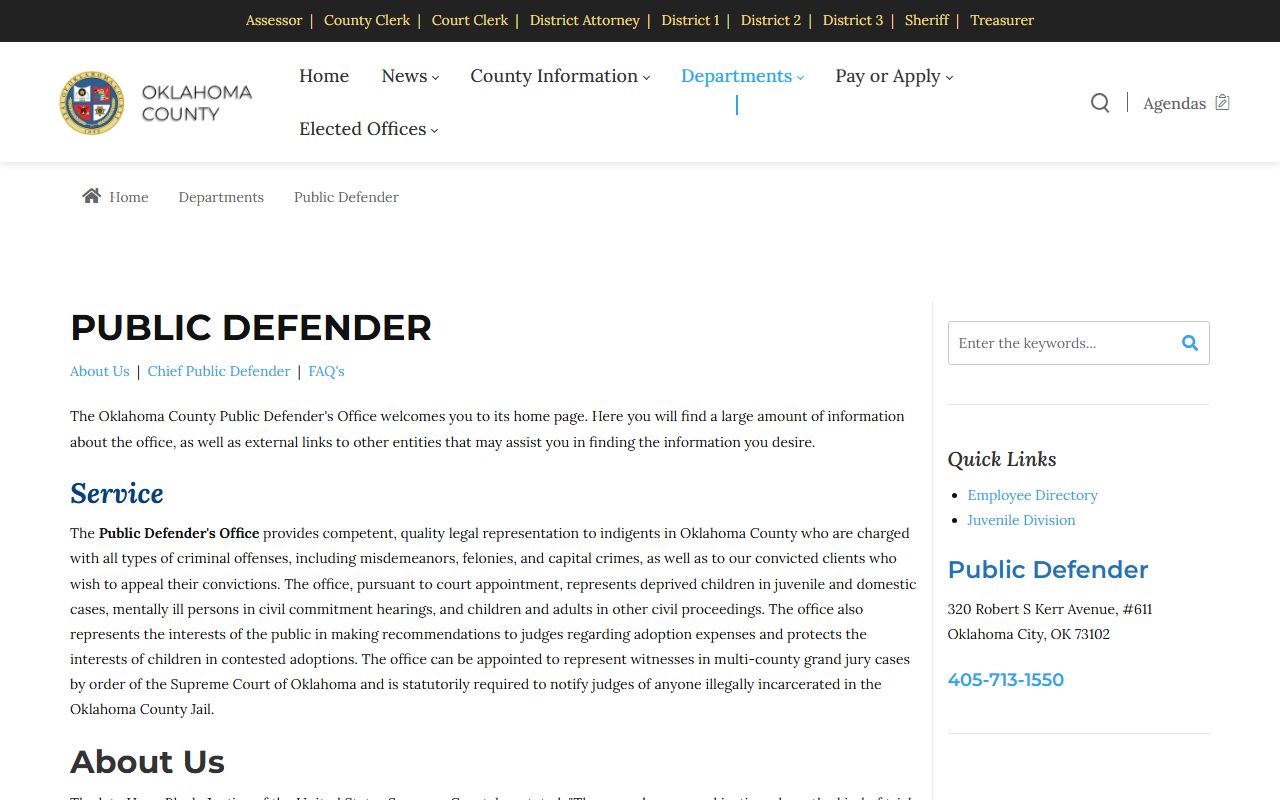
The Public Defender's main line is 405-713-1550. The office also represents people who appeal a conviction, plus some clients in juvenile and civil commitment matters.
Note: Appointed counsel is tied to need, so a defendant who bonds out should still ask the judge about a public defender at the next court date rather than wait.
Charges vs. Convictions
A charge is an accusation. A conviction is a result. The two are not the same, and the gap matters when you read a record. A person can be charged and later cleared. The charge still shows in the public file, yet the disposition tells the real story. Always read the outcome, not just the count at the top.
| Charge | Conviction | |
|---|---|---|
| Stage | Accusation | Verdict or plea |
| Burden of Proof | Probable cause | Beyond reasonable doubt |
| Public Record | Yes | Yes |
Statewide Oklahoma Charge Lookups
Court dockets show charges county by county. A full criminal history pulls them together. The Oklahoma State Bureau of Investigation, OSBI, keeps the statewide criminal-history record. OSBI also handles the rules for clearing a record. The agency points expungement eligibility to 22 O.S. Section 18(A) and says plainly that it cannot pre-approve who qualifies.
OSBI lays out those rules on its criminal-history record expungement page. For certified court copies of a charge, the Court Clerk handles requests through its records request form, and the general records line is 405-713-1705. Most public access starts online, since Oklahoma's Open Records Act under 51 O.S. Section 24A.1 backs the public's right to inspect government records.
Oklahoma County Background Checks
A casual name search is not a background check. Employers, landlords, and licensing boards that run formal checks must follow the federal Fair Credit Reporting Act. Those reports come from regulated agencies and carry rules a free docket search does not. A charge that was dismissed or expunged should not weigh against a person, yet a sloppy report can still surface it. For any decision with legal weight, the official court file and a compliant report are the right sources.
Important: This website is not a consumer reporting agency under the FCRA, and its records cannot be used for credit, hiring, housing, insurance, or any other regulated screening purpose.
Sealed vs. Expunged Records
Some charge records leave public view. Sealing hides a record from the public while keeping it intact. Expungement goes further and treats the record as if it never existed. Oklahoma routes eligibility through statute, and the age of an arrest alone does not decide it. A signed court order is what changes what the public can see, and agencies must receive that order before their systems update.
| Sealed | Expunged | |
|---|---|---|
| Visibility | Hidden from public | Destroyed / treated as never existed |
| Law Enforcement | Limited access | Very limited |
| Eligibility | Set by Oklahoma statute and court order | Routed to 22 O.S. Section 18(A) |
Restricted Oklahoma County Charge Records
Not every charge is open to the public. Juvenile charges are confidential under 10A O.S. Section 1-6-102. The Juvenile Bureau handles youth under 18, and those files stay closed except where the law allows. Sealed and expunged charges drop out of public search. Mental-health cases and ongoing investigations may also be withheld, and guardianship files tied to a case carry their own confidentiality.
The county describes youth intake and detention on the Oklahoma County Juvenile Bureau page.
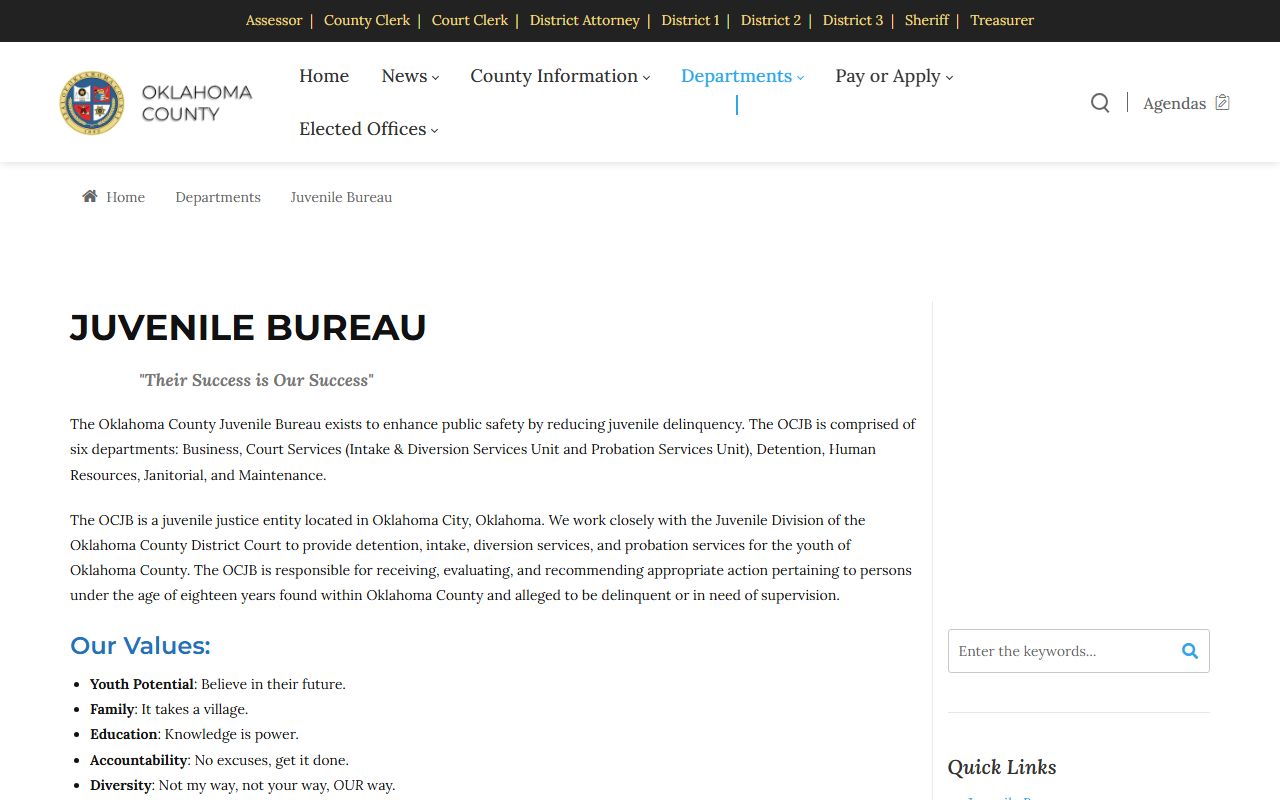
Those records sit apart from the adult charge dockets the public can read. If a search turns up nothing on a name, a restriction may be the reason, and the Court Clerk can confirm whether a file is sealed or simply not online.
Note: When juvenile, sealed, or mental-health restrictions apply, access is usually limited to parties, attorneys of record, guardians, or someone holding a court order.