
Criminal Court Records in Oklahoma County
A criminal court record is the case file the court clerk opens when the State files charges. In Oklahoma County, the Court Clerk keeps that file. It starts the day a charge is filed. It grows with each event after. Clerks log filings, set hearings, and store orders. The file holds the charges as written, the pleas entered, and the final result. The criminal side of the Oklahoma County Court Clerk manages these case records for the District Court, and the office is the place to go for certified copies.
Oklahoma County criminal cases are heard in the District Court. This is the trial court of general jurisdiction for the Seventh Judicial District. Felony cases carry a CF case number. Misdemeanor cases carry a CM number. A felony is the more serious charge and can bring prison time. A misdemeanor brings lighter penalties, such as jail or a fine. Both leave a public case file. Criminal appeals do not go to the state Supreme Court. They go to the Oklahoma Court of Criminal Appeals, one of two high courts in Oklahoma.
How to Search Oklahoma County Criminal Records
The main path to Oklahoma County criminal court records runs through two online systems. The Oklahoma State Courts Network, known as OSCN, is the official statewide docket site. On Demand Court Records, or ODCR, is a second public portal that participating courts publish to. Both let you search by name or by case number at no charge.
- Open OSCN and pick Oklahoma County District Court from the court dropdown.
- Search by the defendant's name, or enter a case number such as CF-2014-1.
- Narrow the results by case type, filing date, or court.
- Open the case to read the docket, charges, plea, and disposition.
- Ask the Court Clerk for a certified copy when you need one for court or legal use.
ODCR works the same way and helps when OSCN runs slow. Both cover Oklahoma County District Court cases. For a statewide criminal history, the Oklahoma State Bureau of Investigation runs a separate background search. Older files and many document images are not online. Those come from the Court Clerk records request form. A closer look at the charges themselves lives in the Oklahoma County arrest records and court charges.
The District Attorney Files Charges
Charges do not appear on their own. A prosecutor decides whether to file them. In Oklahoma County, that work belongs to the District Attorney. Vicki Behenna leads the office. It covers the Seventh Judicial District and ranks as the largest district attorney office in the state. Assistant District Attorneys represent the State of Oklahoma in both misdemeanor and felony cases. They review arrest reports from police and the Sheriff. When they accept a case, they turn that report into a filed charge. That filing is what opens the court record.
The same office has worked to clean up old case data. In one quarter it reviewed 42,000 outstanding misdemeanor warrants dating back to the 1970s, as the county District Attorney accomplishments report describes.
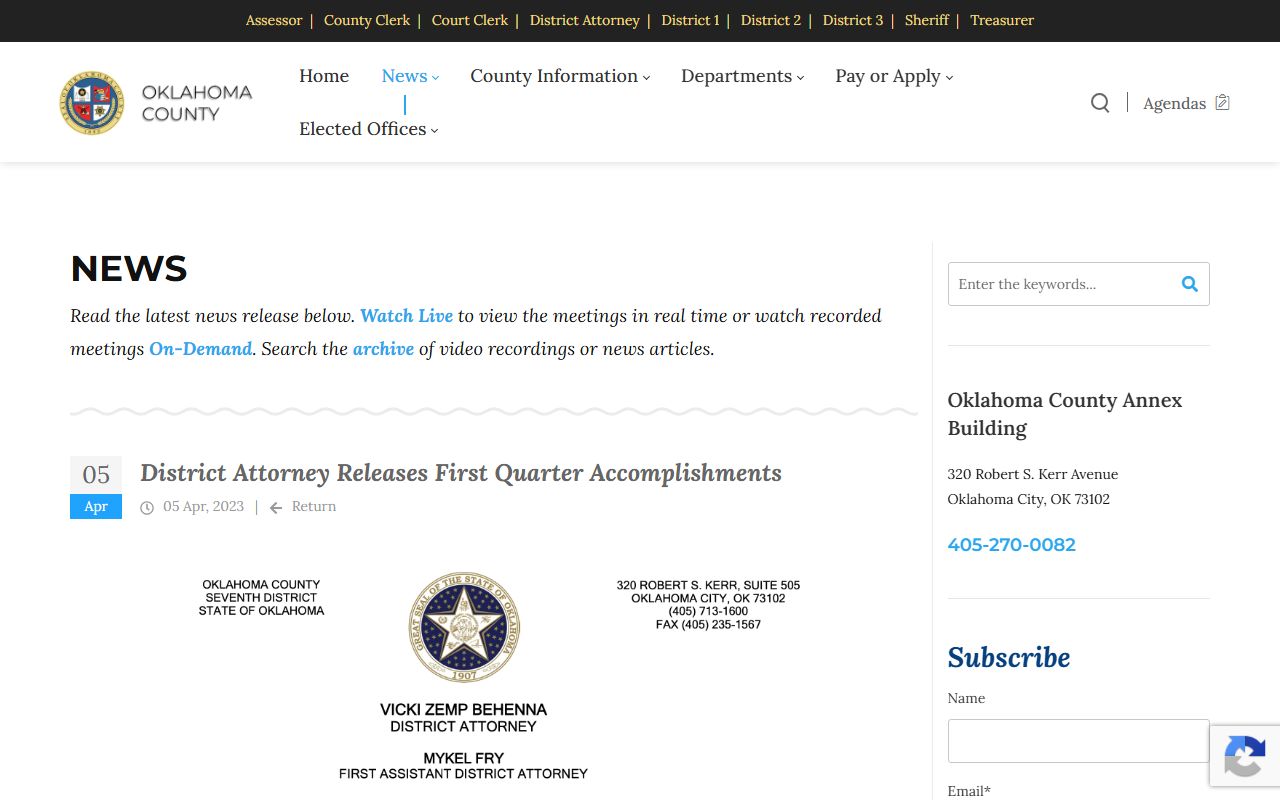
That review shows how charges and warrants tie back to the criminal court file. Each filing, recall, or withdrawal is logged there by date. Most defendants who cannot afford a lawyer get one for free. The Oklahoma County Public Defender represents people charged with misdemeanors, felonies, and capital crimes. Brigitte Biffle runs that office. If a defendant has not bonded out, the court appoints a public defender at the first court date. The public defender line is 405-713-1550.
Stages of an Oklahoma County Criminal Case
An Oklahoma County criminal case moves through set steps. Each one leaves a mark on the record. The docket lists them in order by date.
Case flow: Charges Filed › Arraignment › Pretrial / Motions › Plea or Trial › Disposition › Sentencing
Early entries cover the charge and the first appearance. Middle entries track motions, bonds, and hearings. The last entries hold the result and the punishment. The table below maps the main stages to what shows up in the file.
| Stage | What Happens |
|---|---|
| Arraignment | The first formal hearing. The court reads the charges and takes the plea. |
| Pretrial / Motions | Lawyers file motions, set bond, and argue evidence before any trial. |
| Plea or Trial | The defendant pleads, or a judge or jury weighs the proof and rules. |
| Sentencing | After a conviction, the court sets jail, prison, fines, costs, or probation. |
Inside an Oklahoma County Criminal Record
The case file is built from data fields. A search result shows the same parts each time. Read them together to get the full picture of one case. The list below covers what an Oklahoma County criminal court record shows, field by field.
| Field | What It Shows |
|---|---|
| Case Number | The prefix, year, and sequence. CF marks a felony, CM a misdemeanor, as in CF-2014-1. |
| Defendant | The person charged. The State of Oklahoma is the other party, with attorneys on each side. |
| Charges | Each count with its offense description, statute, and filing date. |
| Plea | How the defendant answered. Guilty, not guilty, or no contest. |
| Disposition | The result of each count. Convicted, dismissed, deferred, or acquitted. |
| Sentence | The penalty after a conviction. Jail or prison, fines, probation, or restitution. |
| Bond | The amount or terms set for release while the case stays open. |
| Costs | Fines, court costs, fees, and any restitution owed. |
| Docket Entries | The dated log of every filing, hearing, order, and warrant. |
Charges Versus Convictions
A charge is not a conviction. The two sit at different points in a case. A criminal court record can show charges that were dropped, dismissed, or that ended in acquittal. Reading the disposition for each count is the only way to know the real outcome. A filed count tells you the State made an accusation. It does not tell you a court found guilt.
| Charge | Conviction | |
|---|---|---|
| Stage | Accusation | Verdict or plea |
| Burden of Proof | Probable cause | Beyond reasonable doubt |
| Public Record | Yes | Yes |
Reading Dispositions and Sentences
The disposition is the heart of an Oklahoma County criminal court record. It says how each count ended. The sentence follows a conviction and lists the penalty. Both can read like code at first. A short glossary clears up the common terms.
- Guilty
- Convicted by a plea or a verdict.
- Not Guilty / Acquitted
- The court did not find guilt. No conviction results.
- Dismissed
- The case or a count was dropped and ends with no conviction.
- No Contest (Nolo)
- The defendant does not fight the charge. It is treated like a conviction for sentencing.
- Deferred Sentence
- Judgment is withheld under set terms. A clean term can lead to dismissal.
A sentence may stack several parts. It can pair jail or prison time with fines, court costs, probation, and restitution. Some sentences run at the same time, and some run back to back. Watch for later entries too. A probation review or a revocation can change a sentence after the first ruling.
Sealed Versus Expunged Records
Two tools can pull an Oklahoma County criminal record out of public view. A sealed record is hidden by law or by court order. An expunged record is treated as if it never existed. The two differ in how fully they hide the file and in who can still reach it. Oklahoma routes expungement eligibility to statute, and the State Bureau of Investigation says it cannot pre-approve a case.
| Sealed | Expunged | |
|---|---|---|
| Visibility | Hidden from public | Treated as never existed |
| Law Enforcement | Limited access | Very limited |
| Eligibility | By law or court order | 22 O.S. § 18(A); OSBI cannot pre-approve |
Clearing a record takes a few clear steps. Pull the case details first, then file in the proper court.
- Gather the case number, arrest date, charge, and disposition from OSCN, ODCR, or Court Clerk copies.
- Check eligibility under 22 O.S. § 18(A). OSBI cannot pre-approve it.
- File the petition in the proper court and give notice to the affected agencies.
- Obtain a signed order from the judge.
- Send the order to the Court Clerk, the arresting agency, the jail, and OSBI so the records update.
Note: Confirm current filing fees and service rules with the Oklahoma County Court Clerk before you file, because requirements can change and an order must reach every agency that holds the record.
Oklahoma County Criminal Record Access
Oklahoma keeps court files open by default. The public has a right to see most Oklahoma County criminal case records. Start online with OSCN and ODCR for any case that is not sealed. When a file is older, document-specific, or needs a certified or authenticated copy, the Court Clerk request form fills the gap. County office records outside the court file route through a separate open-records request instead.
Key Statutes:
Oklahoma Statutes title 51 § 24A.1 et seq. - the Open Records Act gives the public a right to inspect and copy government records, including most court files.
Court of Criminal Appeals Rule 2.6 - OSCN's online case search is a public convenience, but the official clerk file controls if the two disagree.
Restricted Oklahoma County Criminal Records
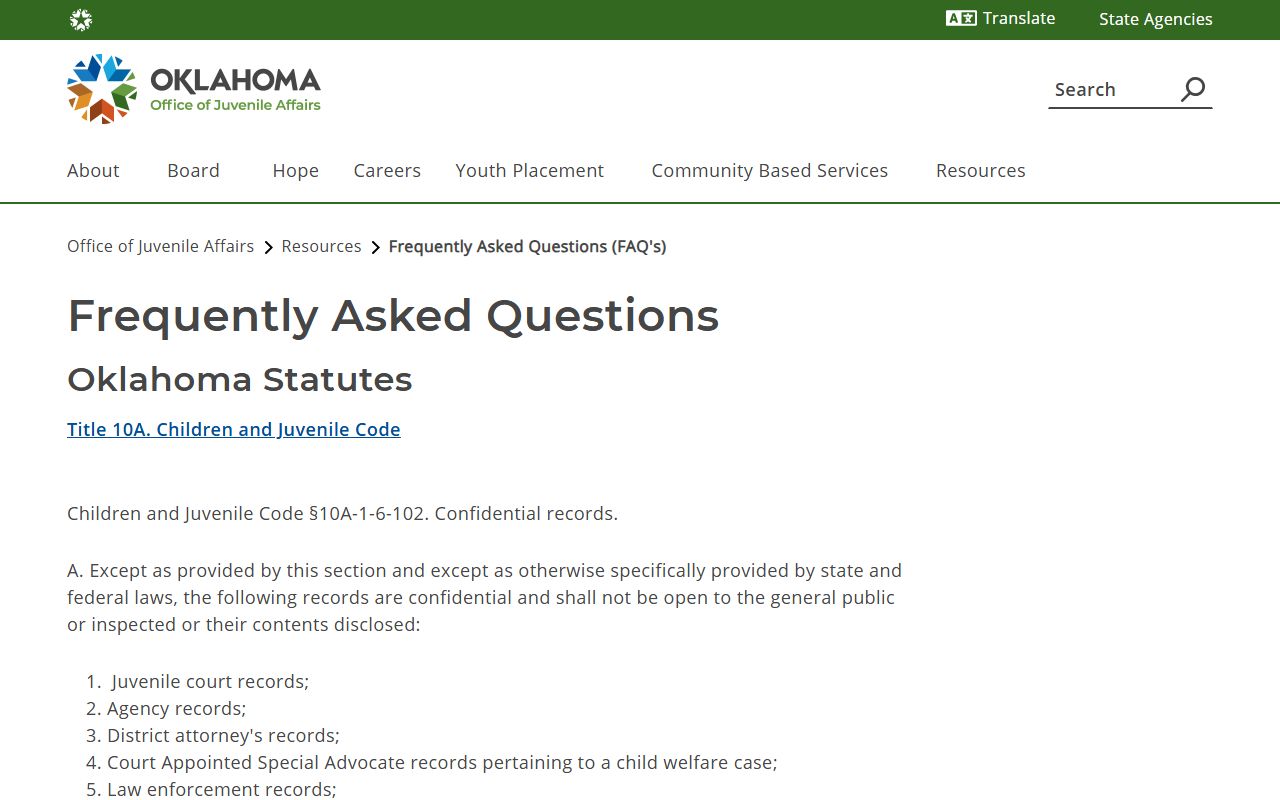
Not every criminal file is open. State law shields several kinds. Juvenile cases are confidential. The Office of Juvenile Affairs cites 10A O.S. § 1-6-102, which keeps listed juvenile records out of public view unless an exception applies. Oklahoma County's Juvenile Bureau works with the Juvenile Division of the District Court on these matters. Sealed and expunged adult cases drop out of public search the same way, along with adoption, mental health, and guardianship files.
The state juvenile agency answers common questions about who may see these files on its juvenile records FAQ page.
Court copies may also blank out Social Security numbers, financial accounts, and protected addresses. Jail and booking data are not court records at all. Current custody shows on the Oklahoma County jail roster, which is a separate system from the case file.
Important: This site is not a consumer reporting agency under the Fair Credit Reporting Act, so its records may not be used for employment, tenant, or credit screening.