
How to Search Oklahoma County Court Records
The Oklahoma State Courts Network, known as OSCN, is the main statewide docket system for district court cases. Its docket page at oscn.net/dockets offers a Case Number Lookup, a name search, an available-court list, and daily docket reports. Oklahoma County District Court sits in the County or Court dropdown. A second official channel, On Demand Court Records at odcr.com, publishes records for participating Oklahoma courts. ODCR is handy when OSCN runs slow or when you want a partial name search.
Gather a few details first. A case number speeds the search, but a full party name works too. Oklahoma case numbers use a prefix, a year, and a sequence, such as CF-2014-1. The CF prefix marks a felony. CM marks a misdemeanor, CJ marks a civil case, and PB marks probate. Knowing the rough filing year helps narrow long result lists.
- Open the OSCN docket page and choose the Case Number Lookup tool.
- Pick "Oklahoma County District Court" from the County or Court dropdown.
- Enter the case number in the CF-2014-1 format, or switch to a name search instead.
- Review the docket sheet for parties, charges, hearing dates, and filed documents.
- If a document is not posted online, note the case number and order a copy from the Court Clerk.
Online dockets are a convenience tool, not the official file of record. The court spells out that limit in Court of Criminal Appeals Rule 2.6.
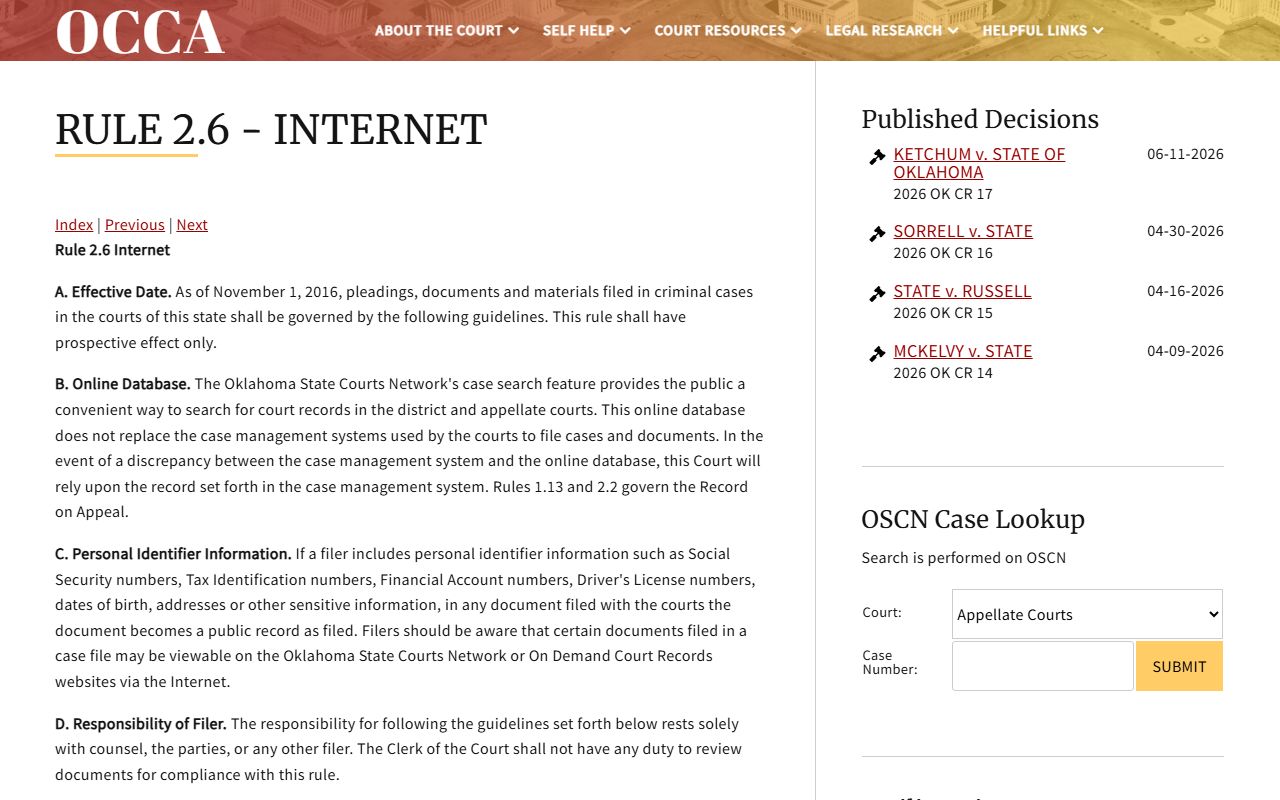
Rule 2.6 calls OSCN a public database that does not replace the official case-management system if the two ever disagree. For anything headed to a hearing, the certified file from the clerk controls. Treat the online docket as your starting map and confirm the detail that matters with the office that holds the paper.
Oklahoma County Court Record Search Fields
The OSCN Case Number Lookup keeps its form short. You pick the court, type a case number, and submit. The example format shown on the page is CF-2014-1, which tells you exactly how the prefix, year, and sequence fit together. A separate name search lives on the same docket landing area for users who do not have a number in hand.
| Field Label | Type | Required | Notes / Format |
|---|---|---|---|
| County or Court | Dropdown | Yes | All Available Oklahoma Courts; Appellate Courts; Oklahoma County District Court; other county district courts |
| Case Number | Text | Yes | Example shown: CF-2014-1 |
| Go | Button | n/a | Submits the case-number lookup |
ODCR carries a wider search form for name and case-type lookups. Oklahoma County appears in the court dropdown simply as "Oklahoma," with the value 055-. Party names use a Last, First format. The case-type menu separates felony, misdemeanor, traffic, probate, guardianship, small claims, protective orders, and more.
| Field Label | Type | Required | Notes / Format |
|---|---|---|---|
| Court group | Dropdown | No | All Courts; Oklahoma District Courts; Tribal Courts |
| Court | Dropdown | No | Oklahoma County listed as "Oklahoma" (value 055-) |
| Party name | Text | No | Format: Last, First |
| Party type | Dropdown | No | Plaintiffs & Defendants; All Parties |
| Type of case | Dropdown | No | Felony, misdemeanor, traffic, probate, guardianship, small claims, and others |
| Full case number | Dropdown + text | No | Prefix dropdown paired with the number fields |
| Search | Button | n/a | Posts the query to the results page |
ODCR advertises free, unlimited searching of public records from courts that publish through it. The daily docket views on OSCN run the other way, sorted by judge, event, or case type rather than by one name. For a calendar of upcoming hearings rather than one single file, the daily docket reports are the better entry point.
Types of Oklahoma County Court Records
The District Court is a general-jurisdiction trial court. It hears almost every kind of state case filed in the county, so its records run wide. Civil disputes, criminal charges, divorces, estates, and traffic citations all land in the same court system. Each case type carries its own prefix and its own access rules. Some files are fully public. Others, such as juvenile and guardianship matters, are closed by statute.
Oklahoma district courts handle the bulk of the cases a resident will ever search. The state describes how that level works on the Oklahoma.gov district courts page.
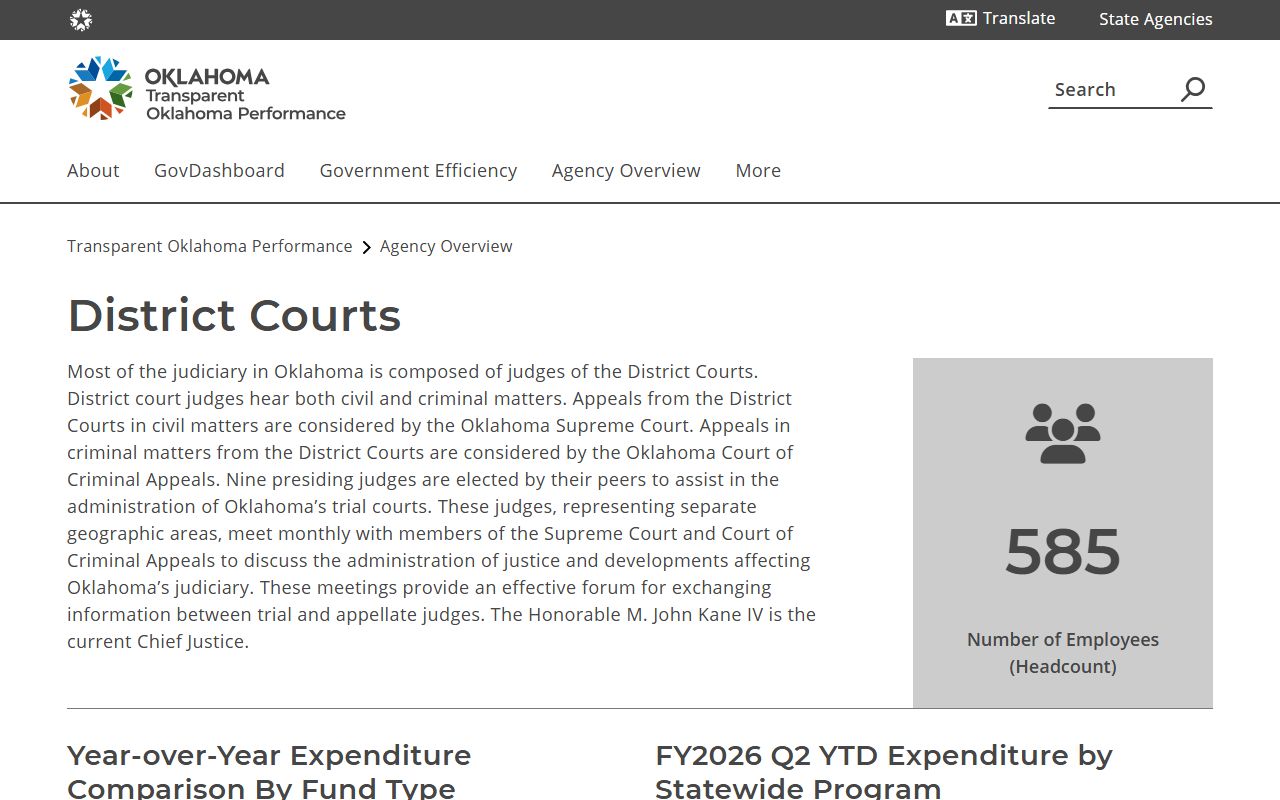
Oklahoma County is the state's largest district court, seated in the Seventh Judicial District. The case categories below show up most often in OSCN and ODCR results.
- Civil cases: small claims, money damages, garnishments, liens, and money judgments.
- Criminal cases: felony and misdemeanor filings, charging documents, pleas, and sentencing orders.
- Family and domestic: divorce, custody, paternity, child support, and protective order petitions.
- Probate: estate administration, wills, guardianships, conservatorships, and trust matters.
- Traffic: county citations paid or contested through the Court Clerk, apart from city tickets.
- Warrants: bench warrants, search warrants, and failure-to-appear warrants tied to open cases.
Marriage licenses are issued by the Court Clerk and are not searched as ordinary dockets. Land deeds, mortgages, and UCC filings never appear in court records at all. Those sit with the County Clerk on a different portal.
What Oklahoma County Court Records Show
A docket sheet is a running log of a case. It lists who is involved, what was filed, when each event happened, and how the matter ended. Criminal files add charges, pleas, and sentences. Civil files add claims, judgments, and money owed. The table below maps the fields you will see when a case record opens.
| Field | What It Shows |
|---|---|
| Case Number | Prefix, year, and sequence, such as CF-2014-1; the prefix marks the case type. |
| Parties | Plaintiff, state, or petitioner against the defendant or respondent, plus listed attorneys. |
| Filing and Docket Dates | Date filed, event dates, hearing dates, disposition date, and cost due dates. |
| Judge and Courtroom | Assigned judge, courtroom number, docket type, and the day's docket link where posted. |
| Charges and Counts | Offense description, statute cited, count number, plea, disposition, and sentence. |
| Docket Entries | Motions, orders, minutes, arraignment, plea, continuance, and judgment lines. |
| Financials | Fines, court costs, assessments, restitution, bond amounts, and payment plans. |
| Documents | Plain, certified, or authenticated copies from the Court Clerk; online images vary. |
| Redactions | Juvenile, adoption, guardianship, sealed, and personal identifier data removed or hidden. |
Read the prefix first. It tells you the case lane before you read a single line. CJ points to a civil suit, FD to a family matter, PB to probate, and PO to a protective order. The financial lines matter too. Unpaid court costs can trigger a failure-to-pay warrant, which then shows up as its own docket entry.
Note: Online docket images are often partial, so older documents and full pleadings frequently need a direct copy request from the Court Clerk.
Public Access to Oklahoma County Court Records
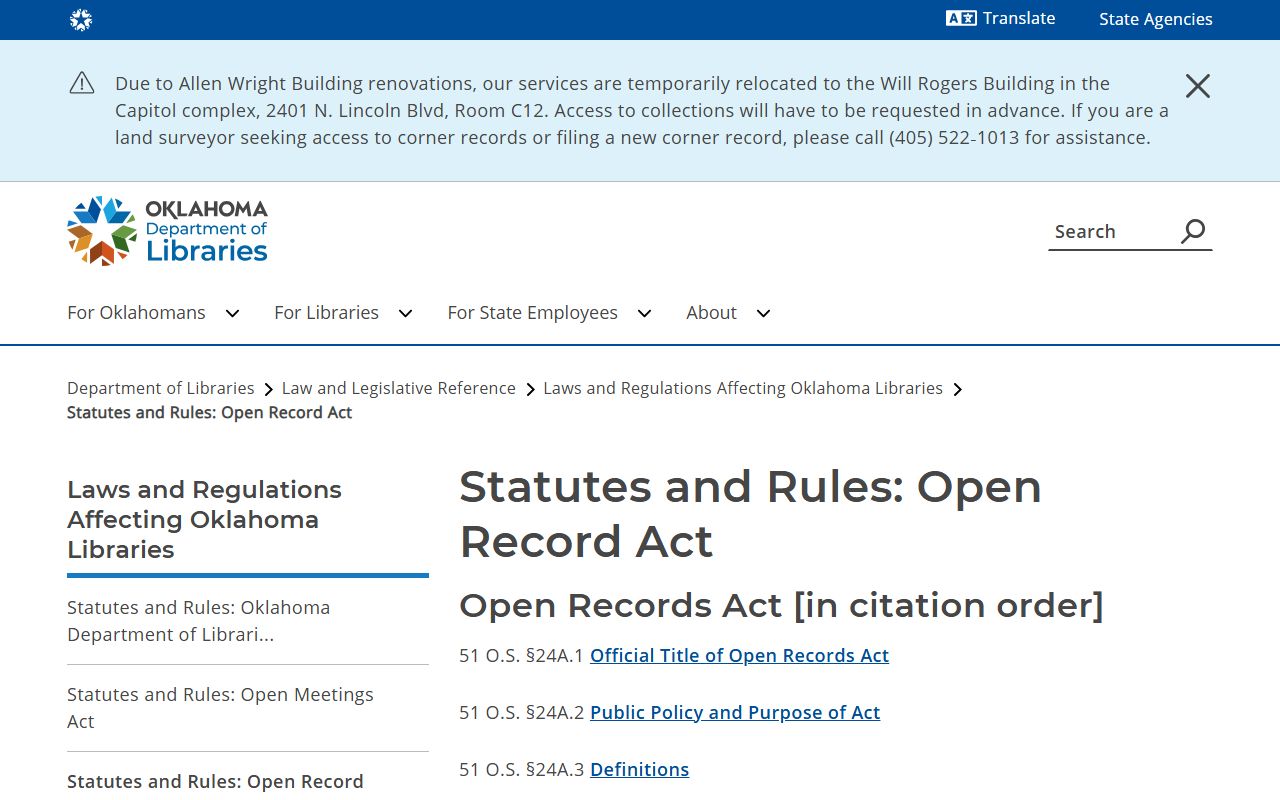
Oklahoma starts from a presumption of openness. The Open Records Act, found at 51 O.S. Sections 24A.1 and following, says the public has a right to know about government records, subject to listed exceptions. Public bodies keep their records open for inspection and copying during regular business hours unless a statute makes a file confidential. The court system layers its own rules on top of that baseline.
The complete list of Open Records Act sections lives on the Oklahoma.gov Open Records Act page.
For most court files, the rules are simple. Anyone may search OSCN or ODCR for nonsealed records without an account or a reason. The free online docket covers the day-to-day need. Rule 2.6 reminds users that the online version is a database, not the certified file. When a copy must stand up in court, only the clerk's certified version counts.
Note: The Open Records Act opens government files by default, but juvenile, sealed, expunged, and guardianship court records stay closed unless a statute or judge allows access.
Sealed and Confidential Court Records
Not every case is open. Several categories are confidential by statute, and the clerk will not hand them over without authority. Juvenile records are the clearest example. Under 10A O.S. Section 1-6-102, the records the statute lists are confidential and closed to the general public unless an exception applies. The Office of Juvenile Affairs spells that out on its juvenile records FAQ.
Guardianship files carry similar protection. Only the attorneys of record, the guardian, or the ward may review a guardianship file without a court order. Adoption and mental-health matters are also treated as sensitive rather than ordinary public dockets. A name may surface in a search index while the documents behind it stay locked.
Expungement is the route to seal a qualifying criminal record. The Oklahoma State Bureau of Investigation points eligibility to 22 O.S. Section 18(A) and warns that it cannot pre-approve a request. The agency lays out the steps on its criminal history expungement page. A person clearing a record first pins down the exact case number, charge, and disposition, files the petition in the proper court, gives notice to the affected agencies, and obtains a signed order. After the judge signs, the order must reach the Court Clerk, the arresting agency, and OSBI so each system updates.
Request Oklahoma County Court Records in Person
When a record is not online, when you need a certified or authenticated copy, or when a file is old or document-specific, the request runs through the Court Clerk. Rick Warren's office maintains district court filings, dockets, marriage licenses, traffic tickets, court costs, and copy requests. You can file the request form online, mail a payment by check or money order, or visit the records counter on the fourth floor.
The office confirms fees by email within ten business days, then allows another ten business days for processing after payment arrives. Copies run one dollar for the first page and fifty cents per added page. Certification of a document is fifty cents, and an authentication certificate is five dollars. Certified copies cannot be emailed, so include a self-addressed envelope when you mail a request. For deeper detail on forms and fees, the Oklahoma County Court Clerk page walks through each step.
Oklahoma County Court Clerk
Rick Warren, Court Clerk
320 Robert S. Kerr Ave, Room 500
Oklahoma City, OK 73102
405-713-1705
Mon-Fri 8:30 a.m.-5:00 p.m.
The county also runs an Open Records Request page for files outside the court system. That form routes court-file questions back to the Court Clerk at the same phone line, and other departments by online form. For older estate files or specific pleadings, the request form asks for the decedent or party name, case number, approximate filing year, and document titles.
Municipal and County Clerk Record Channels
District court files are only one of several record systems in downtown Oklahoma City. Two separate channels catch cases that OSCN will never show. Mixing them up wastes time, so it pays to know the split before you search.
City tickets and ordinance cases belong to Oklahoma City Municipal Court, not the District Court. The municipal court runs its own case and payable-ticket lookup, and a city bench warrant may not appear in the county system at all. A speeding ticket inside Oklahoma City limits is a municipal matter. A county traffic citation goes through the Court Clerk instead. The Oklahoma County traffic court records page sorts out which venue holds which ticket.
Land records are the other separate track. The County Clerk, Maressa Treat, keeps deeds, mortgages, plats, and UCC filings on the okcc.online portal, with name, document-type, book-and-page, and instrument-number searches. Those records never live on a court docket. A title search, a lien check, or a UCC lookup starts at the County Clerk, while a lawsuit or criminal case starts at the Court Clerk. Both offices share the 320 Robert S. Kerr address, yet each holds a different half of the public record.