
Oklahoma County District Court Overview
Oklahoma builds its trial courts as district courts. These are courts of general jurisdiction. General jurisdiction means one court can hear nearly any kind of case. The Oklahoma County District Court takes civil suits, criminal charges, family disputes, probate, juvenile matters, protective orders, small claims, and traffic cases. Few state courts hold a wider mix. The same building handles a claim worth a few dollars and a felony trial.
The state runs 77 district courts in all. Each county has one or more district judges plus an associate district judge. Judges win their seats in nonpartisan elections for four-year terms. Oklahoma County falls inside the Seventh Judicial District. That makes it the home court for residents of Oklahoma City and the rest of the county.
Most people reach the court for one of a few reasons. They have a case. They want to look up someone else's case. Or they need a copy of a filed document. The court's structure points each of those needs to the right office or judge.
Oklahoma County District Court Divisions
The District Court is not one room. It spreads across divisions and a few related offices. Civil, family, and criminal dockets each have assigned judges. Probate sits inside the District Court as a division, not as a separate probate court. The Juvenile Division works alongside the county Juvenile Bureau. City ordinance and most local traffic tickets go to a separate municipal court. The table below lists the core courts and divisions a county case may touch.
| Court / Division | Address | Phone | Notes |
|---|---|---|---|
| Oklahoma County District Court | 321 Park Avenue, Oklahoma City, OK 73102 | 405-556-9300 | General jurisdiction trial court. |
| Oklahoma County Court Clerk | 320 Robert S. Kerr Avenue, Room 500, Oklahoma City, OK 73102 | 405-713-1705 | District Court filings, records, marriage licenses, traffic tickets, costs. |
| Probate Division | District Court / Court Clerk | 405-713-1705 | Estates, guardianships, conservatorships, trusts, wills for safekeeping. |
| Juvenile Division / Juvenile Bureau | Oklahoma County Juvenile Bureau | See Juvenile Bureau | Intake, detention, diversion, probation for youth under 18. |
| Oklahoma City Municipal Court | 701 Couch Drive, Oklahoma City, OK 73102 | 405-297-2884 | City ordinance, parking, and municipal traffic cases. |
Notice that records do not all live in one place. The Court Clerk holds district-court case files. Land and county records sit with the County Clerk. A municipal ticket stays with the city court. Sorting the venue first saves a wasted trip.
Note: Probate is a division of the District Court here, so estate and guardianship cases run through the same Court Clerk that handles civil and criminal filings.
Oklahoma County District Court Judges
The bench in Oklahoma County is large. The official courthouse directory lists 15 District Judges, 1 Associate District Judge, and 21 Special Judges. District Judges handle the heaviest civil and criminal dockets. Associate and Special Judges take on assigned dockets, preliminary hearings, small claims, and other matters. Each judge has a courtroom, a bailiff, and a minute clerk.
The court keeps a public roster of its judges and their courtrooms. To see the full list, visit the Oklahoma County District Judges page, which carries each judge's name and contact details.
View the Oklahoma County District Court judges directory.
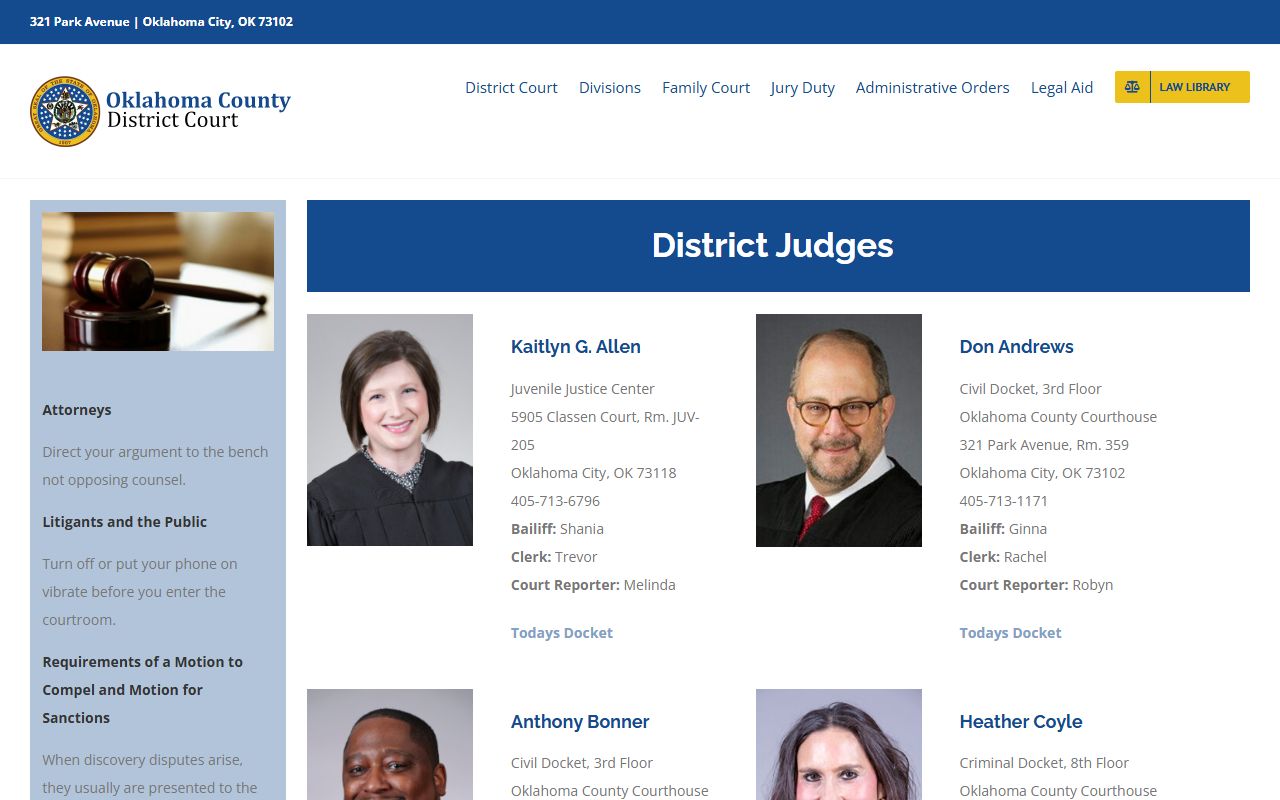
That roster names judges such as Kaitlyn G. Allen, Don Andrews, Anthony Bonner, Heather Coyle, C. Brent Dishman, Lydia Y. Green, Nikki Kirkpatrick, and Natalie Mai. Courtroom assignments help when you need to call ahead. Judge Dishman hears a civil docket in Room 315 on the third floor at 405-713-1451. Judge Green sits in Room 722 at 405-713-7101. Each entry also links to daily docket reports for that judge.
Phone the right courtroom and you can confirm a hearing time, a docket sounding, or a continuance. Staff cannot give legal advice. They can tell you where and when a case is set.
District Court vs. Municipal Court
Many people mix up the District Court and a city court. They are not the same. The District Court is a state court of general jurisdiction. Oklahoma City Municipal Court is a city court. It handles violations of city ordinances, parking, and most local traffic. The table sorts out the main differences and shows where an appeal lands.
| District Court | Municipal Court | |
|---|---|---|
| Jurisdiction | General; civil, criminal, family, probate, juvenile | City ordinance and municipal traffic |
| Typical Cases | Felonies, misdemeanors, lawsuits, divorce, estates | Tickets, parking, code violations |
| Governing Body | State of Oklahoma | City of Oklahoma City |
| Civil Appeals Go To | Oklahoma Supreme Court | District Court, then Supreme Court |
| Criminal Appeals Go To | Court of Criminal Appeals | District Court, then Court of Criminal Appeals |
The split matters for records too. A county criminal case shows up in district-court systems. A city ticket lives in the municipal court's own portal. Search the wrong system and the case looks like it does not exist.
How a Case Moves Through the System
Oklahoma is unusual at the top. It has two courts of last resort. Civil appeals go to the Oklahoma Supreme Court. Criminal appeals go to the Oklahoma Court of Criminal Appeals. The Oklahoma Court of Civil Appeals sits in the middle for civil matters the Supreme Court assigns to it. Both paths start at the District Court. The Oklahoma district courts overview explains the split.
Criminal flow: Arrest › First Appearance › Information or Indictment › Arraignment › Preliminary Hearing › Trial › Sentencing › Court of Criminal Appeals
Civil flow: Petition Filed › Answer › Discovery › Pretrial › Trial › Judgment › Court of Civil Appeals or Supreme Court
Most cases never reach an appeal. They end at the trial court through a plea, a settlement, a dismissal, or a judgment. Still, the route helps explain why one record may live in two court systems over its life.
Note: Because civil and criminal appeals travel to different high courts, the appellate history of a case depends on whether it began as a civil or criminal matter.
The Seventh Judicial District
Oklahoma County stands alone as the Seventh Judicial District. The district covers the whole county, including Oklahoma City, the state capital. That makes it one of the largest and busiest trial-court districts in Oklahoma. The county's District Attorney's office also describes itself as the largest in the state, which fits the volume of criminal cases filed here.
Volume shapes how the court runs. With a deep bench and many special judges, dockets are divided by case type and by judge. A civil suit, a felony, and a probate matter each route to different judges and different daily dockets. The roster of judges keeps those assignments current.
Oklahoma County Courthouse Location
The District Court sits in downtown Oklahoma City. The Oklahoma County Courthouse is at 321 Park Avenue, Oklahoma City, OK 73102. Many district judges have courtrooms in that building. The Court Clerk's records and payment counter is a short walk away at 320 Robert S. Kerr Avenue, Room 500. Office hours run Monday through Friday, roughly 8:00 a.m. to 5:00 p.m.
For the courthouse address and business hours, check the District Court contact page before you travel.
See the Oklahoma County District Court contact and hours page.
The downtown cluster is dense. County, municipal, state, and federal court buildings all sit within a few blocks. A visitor can have a county case at the District Court, a city ticket at Municipal Court, and a federal matter nearby on the same day. The County and Metro parking garage north of the annex serves courthouse visitors, so confirm current rates before you arrive.
Oklahoma County District Court Dockets
Daily dockets and case files are public for most case types. The Oklahoma State Courts Network, known as OSCN, is the primary statewide system. It carries case-number lookups for Oklahoma County District Court and daily district court reports by judge, event, and case type. You can reach it at the OSCN docket landing page. A second portal, On Demand Court Records, offers free searching for participating courts when OSCN is slow.
Use these systems to find a case number, a hearing date, or a docket entry. For a closer look at how dockets read and what each entry means, the county court dockets page breaks down the fields. When a record is older, certified, or not online, the request runs through the office of the Court Clerk instead.
Online dockets cover most criminal, civil, family, probate, and traffic cases. Sealed, juvenile, guardianship, and mental-health files are restricted by law. Those do not appear as ordinary public dockets.
Note: OSCN's online search is a public convenience and does not replace the official court case-management record if the two ever conflict.
Accountability Courts in Oklahoma County
The District Court runs problem-solving programs alongside its regular dockets. These are often called accountability courts. They aim to treat the cause of repeat offending instead of only punishing it. Two appear directly in county case-type lists.
- Drug Court, a supervised treatment track for qualifying defendants, with its own monthly program fees.
- Anna McBride Act Mental Health Court, which handles cases tied to serious mental illness.
- Juvenile diversion through the Juvenile Bureau, which works with the District Court's Juvenile Division.
These dockets matter to anyone reading a criminal file. A case may show treatment-court events rather than ordinary sentencing entries. Some mental-health and juvenile records are also restricted by statute, so they may appear only as a case label or not at all in public search.
Federal Court in Oklahoma City
Not every case in Oklahoma City is a county case. Federal matters belong to the U.S. District Court for the Western District of Oklahoma. The federal courthouse sits downtown near the county buildings. It hears federal crimes, federal civil suits, civil-rights claims, and other matters under federal law. That court is separate from the Oklahoma County District Court.
Federal filings use a system called CM/ECF, with public access through PACER. You can learn how that works on the Western District CM/ECF page.
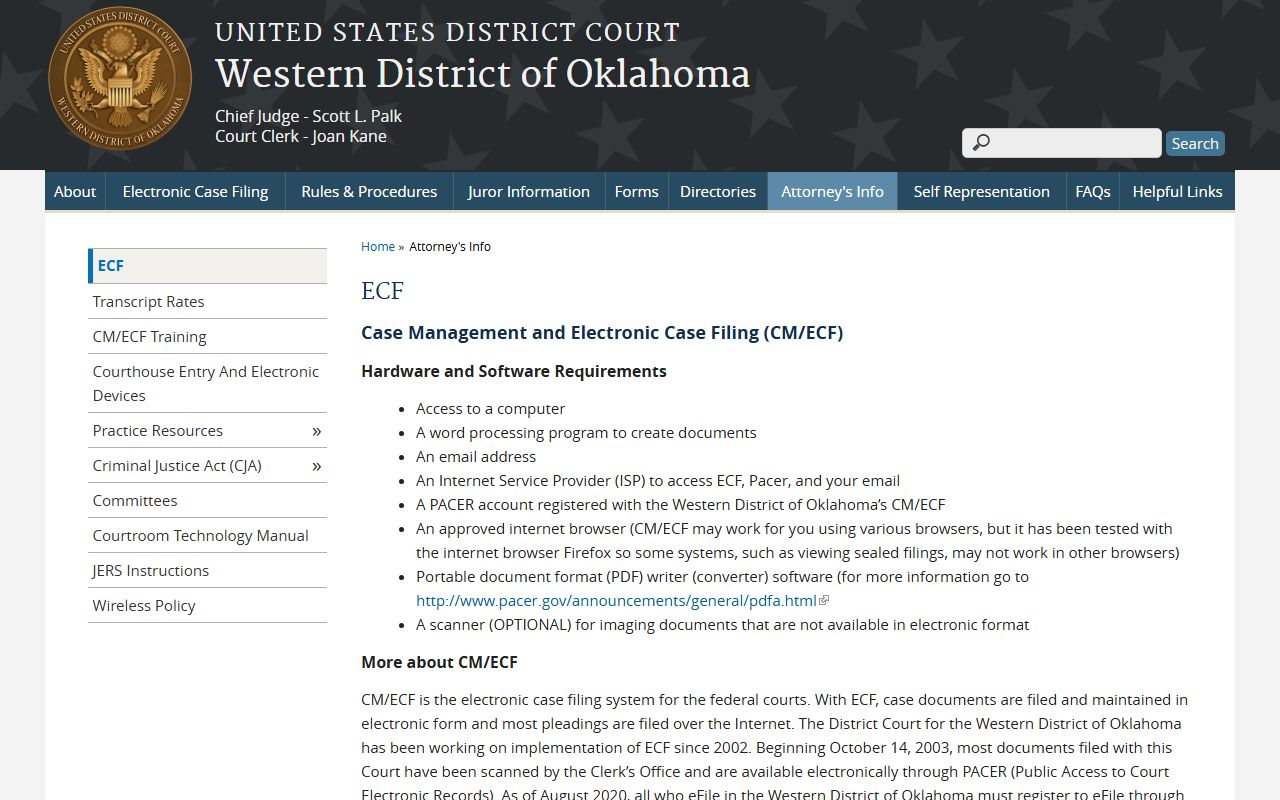
Most federal pleadings filed since 2003 are scanned and reachable through PACER. So a federal case will not show up in OSCN or ODCR. If a case is not in the county systems, the federal court is one place worth checking. The two systems run on completely different software and rules.